Save up to 73% on plans

Seedance 2.5 Prompt Library
Sign In
Prompt guide and text builderSources reviewed October 30, 2026

Seedance 2.5 Prompts: Build a Production-Ready Video Brief

Choose a direction, edit the subject, action, setting, camera, style, and sound, then copy one structured brief. The builder is useful immediately and keeps each instruction in a clear lane instead of stacking decorative adjectives.

Start from a practical direction
Camera, style, and audio controls

Copy-ready brief

Your structured prompt

[FORMAT]
8 seconds, 16:9 landscape, one coherent sequence; use explicit cuts only when named

[SUBJECT]
One unbranded cobalt-blue portable speaker; preserve its compact cylinder, woven grille, metal dial, and exact proportions.

[ACTION AND TIMING]
0–3s: the speaker rests still. 3–6s: the dial turns once and a soft status glow appears. 6–8s: the camera settles on the grille and dial with the product unchanged.

[SCENE]
Minimal walnut listening room at blue hour, realistic contact shadow, subtle dust in the light, no competing products.

[VISUAL STYLE]
Premium commercial realism, restrained contrast, natural materials, clean highlights.

[CAMERA]
Begin at tabletop height with a 50mm product close-up, slow controlled half-orbit, stop before the final frame.

[AUDIO]
Quiet room tone, one tactile dial click, low unobtrusive music bed, no voiceover.

[CONTINUITY]
Preserve subject identity, object geometry, wardrobe, screen direction, lighting logic, and prop ownership from the opening frame to the ending state.

[CONSTRAINTS]
No accidental text, logos, duplicate subjects, extra limbs, unexplained object changes, random cuts, or camera movement that conflicts with the scene plan.

This builder creates a text brief and does not generate video. Open the Seedance 2.5 model page to review the current model, supported inputs, controls and displayed credit cost before submitting. Provider capabilities described here may exceed the inputs offered by a particular generator.

What This Seedance 2.5 Prompt Guide Can—and Cannot—Promise

ByteDance officially describes Seedance 2.5 as an audio-video model for up to 30-second storytelling, multimodal reference control, and timestamp-level editing. Prompt discipline can express those intentions, but it cannot guarantee compliance or replace a verified provider contract.

Official capability, portable technique

Timed beats, reference roles, continuity rules, camera blocking, and audio lanes reflect the model's published creative direction. Every template remains editable so it can travel to the interface where you actually have access.
Check the generator controls

Use the Seedance 2.5 model page for generation. Match the prompt to its visible duration, reference inputs and audio controls; copying a prompt does not validate the result.

Review beats adjectives

A good result still needs full-clip review for identity drift, object state, hand motion, physical plausibility, lip sync, unwanted text, cuts, sound balance, and whether the ending state matches the brief.

Write Like a Small Production Team

A strong prompt specifies a beginning, change, and ending state, then tells each reference and audio layer what job it owns.

Build the scene contract before the pretty details

Lock the subject, props, environment, direction of travel, and final state first. Add style only after the physical plan is readable. This prevents a visual adjective from silently overriding the action or camera logic.

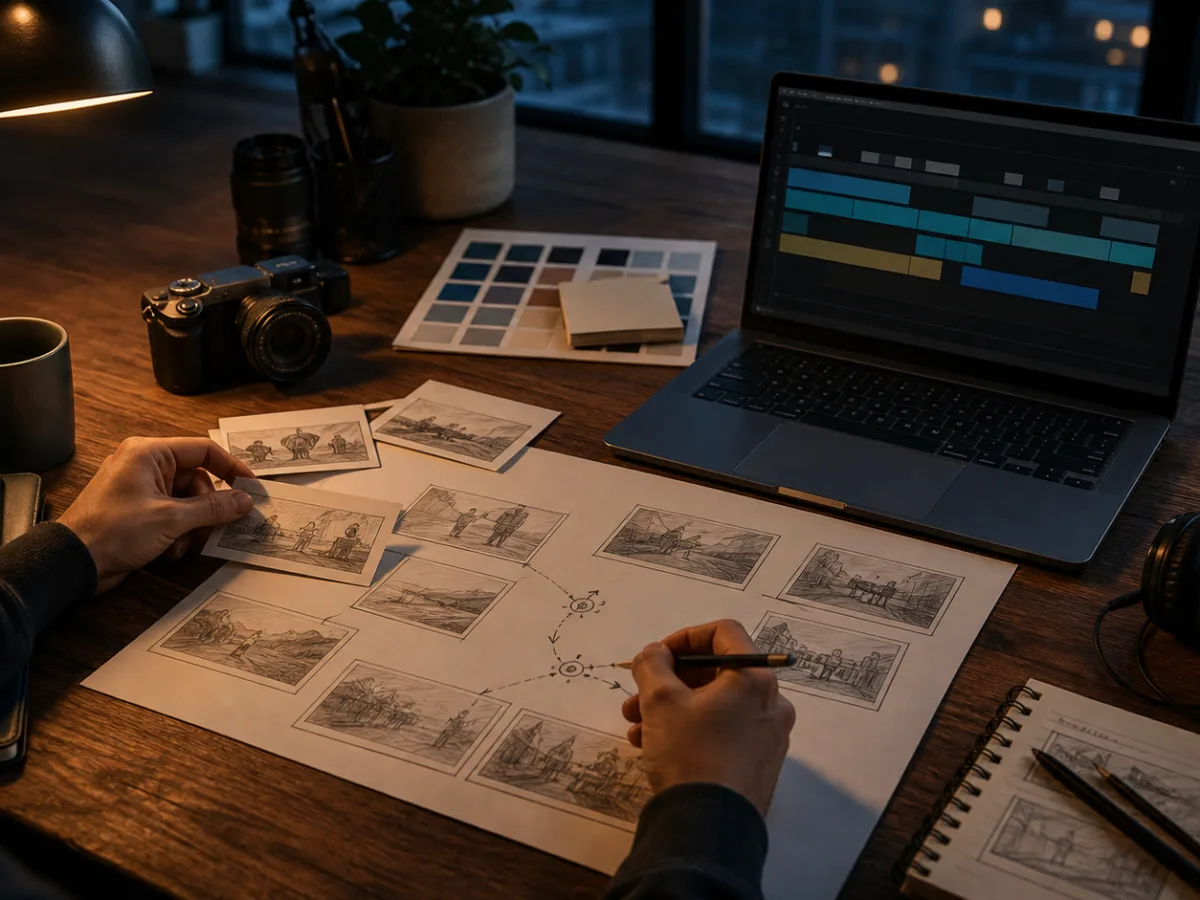
Original editorial photograph of a creator arranging storyboard cards and a camera plan

Adapt the brief to the scene you want

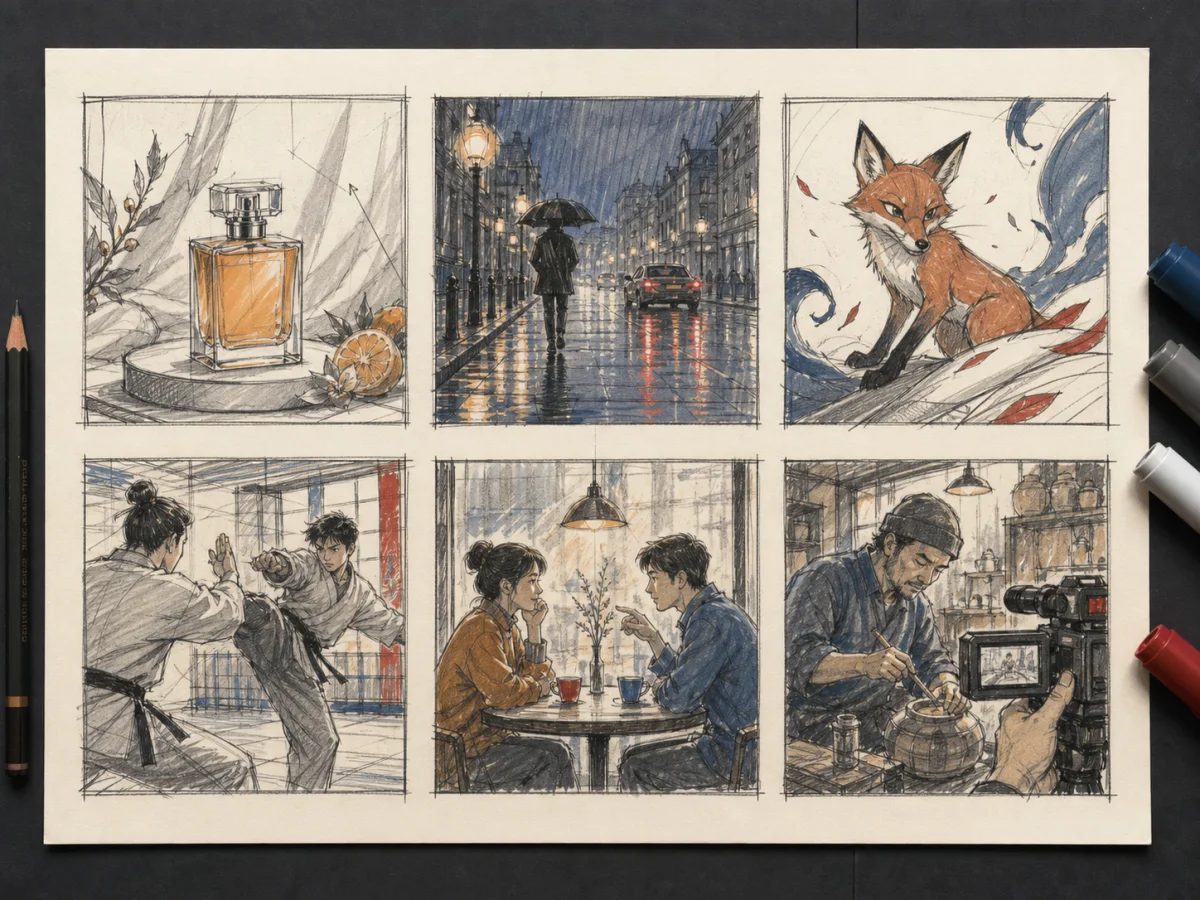
Product, cinematic, animation, action, dialogue, documentary, long-form, and reference-consistency prompts share the same grammar. The examples below change the scene contract and QA focus while preserving one reusable planning method.

Original hand-drawn storyboard contact sheet covering six video prompt directions

Seedance 2.5 Product Prompts

Product briefs should protect geometry, material, labels, and contact shadows while giving the camera one deliberate reveal. Use unbranded objects unless you own the marks and designs.

8-second tabletop reveal

Precision watch reveal

The shot spends its motion budget on one object, one lighting change, and one camera path.

[FORMAT]
8 seconds, 16:9, single continuous take, real-time speed.

[SUBJECT]
One unbranded brushed-steel field watch with a matte cream dial, black minute marks, brown leather strap, and exactly one crown. Preserve case shape, hand positions, strap stitching, and metal finish.

[ACTION AND CAMERA]
0–3s: locked macro view as a narrow warm highlight travels across the bezel. 3–6s: make a slow 30-degree tabletop orbit while keeping the entire watch sharp and centered. 6–8s: lower slightly and settle on the dial and crown. The watch never rotates or changes shape.

[SCENE]
Dark slate surface, soft charcoal background, realistic contact shadow, restrained amber rim light.

[AUDIO]
Quiet studio room tone and one soft leather movement; no voiceover, no music.

[CONSTRAINTS]
No logo, no readable brand text, no extra crown, no melting metal, no floating watch, no cuts, no duplicate product, no watermark.

Revision tip: If the geometry drifts, remove the orbit and prove a locked three-quarter frame before restoring camera motion.

15-second demonstration

Portable espresso workflow

Each time range begins from the state created by the previous range, so liquid level and hand position have continuity.

[FORMAT]
15 seconds, 9:16, one coherent demonstration with no cuts.

[SUBJECT]
One compact cobalt-blue portable espresso maker beside one white cup. Preserve the maker's short cylinder, black grip ring, copper button, clear lower chamber, and exact placement. One natural right hand enters only when specified.

[TIMELINE]
0–4s: medium product frame; the maker and cup remain still. 4–7s: one right hand enters from frame right and presses the copper button once. 7–12s: espresso flows into the clear chamber and the liquid level rises naturally; product body remains rigid. 12–15s: the hand withdraws and the camera shifts slightly to place maker and cup together in the final frame.

[SCENE AND CAMERA]
Warm apartment kitchen, oak counter, daylight, slow level push, no background redesign.

[AUDIO]
Button click, gentle brewing, quiet room tone, distant traffic, no music.

[CONTINUITY]
Keep cup, counter, product geometry, button position, liquid color, hand count, and lighting consistent.

Revision tip: If the hand or liquid fails, keep the same opening and ending frames and simplify the middle to one button press plus one visible level change.

Seedance 2.5 Cinematic Prompts

Cinematic does not mean adding every lens term. Define the dramatic beat, screen geography, dominant camera move, motivated light, and the precise frame where the shot should resolve.

Rainy one-take drama

Courier and tram occlusion

The tram briefly hides the courier without resetting identity, bicycle position, or direction of travel.

[FORMAT]
15 seconds, 2.39:1 cinematic landscape, one continuous take, grounded real-time movement.

[STARTING STATE]
A bicycle courier in a mustard raincoat waits at the left curb with one black bicycle and one sealed kraft parcel. She faces screen right.

[TIMELINE]
0–5s: handheld medium-wide follow as she rolls into the wet intersection. 5–9s: a red tram crosses the foreground and fully occludes her for two seconds; she continues moving behind it without changing direction. 9–15s: she reappears on the same bicycle, accelerates into a narrow side street, and exits screen right.

[CAMERA AND LOOK]
35mm lens feel, camera remains on the same side of the street, gentle operator sway, cool dawn shadows, warm practical lamps, real rain reflections, restrained grain.

[CONTINUITY]
Same face, coat, bicycle, parcel, travel direction, weather, and street layout through the occlusion.

[AUDIO]
Rain, bicycle freewheel, tram bell, wet tires, distant city bed, no score.

[CONSTRAINTS]
No teleport, no duplicate courier, no bicycle redesign, no slow motion, no random cut, no text or logo.

Revision tip: When an occlusion causes a reset, spell out the hidden motion path and the exact re-entry position.

Controlled interior suspense

Archive room reveal

The scene builds tension through focus, sound, and one door action rather than unrelated spectacle.

[FORMAT]
12 seconds, 16:9, three motivated shots with clean cuts.

[SUBJECT]
A night archivist in a charcoal cardigan holds one brass key and a paper inventory card. Preserve face, wardrobe, key, card, and hand occupancy.

[SHOT PLAN]
Shot 1, 0–4s: locked wide view down a narrow archive aisle; she enters from background and stops at cabinet 47. Shot 2, 4–8s: close profile; she reads the inventory card, then hears one knock from inside the cabinet and looks toward it. Shot 3, 8–12s: macro on the key entering the lock, then a slow rack focus to her reflected eye in the cabinet glass; end before the door opens.

[LIGHT AND COLOR]
Single green desk lamp, dim tungsten ceiling practicals, deep but readable shadows, dusty air, muted film palette.

[AUDIO]
Footsteps, paper, one dry knock, key touching metal, low ventilation hum; no music and no dialogue.

[CONSTRAINTS]
Maintain the 180-degree line, one person, one key, one cabinet; no supernatural figure, no extra knock, no opening door, no captions.

Revision tip: If the model opens the cabinet early, repeat the ending state: key inserted, door still closed, cut before reveal.

Seedance 2.5 Animation Prompts

Animation prompts need a consistent design sheet in words: silhouette, palette, materials, scale, expression range, and world physics. Avoid mixing incompatible rendering styles inside one beat.

Stylized character short

Paper fox and the wind

The prompt defines the fox as folded paper and makes every motion respect that material.

[FORMAT]
10 seconds, 16:9, single continuous animated shot.

[CHARACTER CONTRACT]
One small fox made from folded rust-orange paper, cream paper chest, four angular legs, triangular ears, black ink eyes, no mouth. Preserve fold pattern, colors, proportions, and paper material in every frame.

[ACTION]
The fox climbs a stack of old books, pauses at the top as a breeze enters, braces its paper legs, then releases one loose paper leaf that spirals upward. It follows the leaf with its eyes and settles into a proud seated pose.

[WORLD]
Miniature attic library at sunset; all objects have tactile cut-paper and painted-cardboard construction. Wind bends paper gently but never turns objects into cloth or liquid.

[CAMERA]
Low tracking move beside the books, then a small crane rise with the leaf; finish in a stable medium-wide composition.

[AUDIO]
Dry paper rustle, soft wooden room tone, one light celesta phrase.

[CONSTRAINTS]
No fur, no realistic animal anatomy, no extra fox, no mouth, no text, no style change, no torn body parts.

Revision tip: If materials drift, repeat the material rule inside the action: folded paper bends at creases and does not squash like rubber.

Graphic motion design

Modular city rhythm

Abstract movement still has cause, timing, spatial rules, and a final readable composition.

[FORMAT]
8 seconds, 1:1 square, graphic 3D animation, four clean beats.

[DESIGN SYSTEM]
A miniature city made only from cobalt cubes, cream cylinders, amber arches, and thin charcoal roads on an off-white plane. Matte paper-clay surfaces, soft ambient shadows, no letters or logos.

[TIMELINE]
0–2s: locked isometric view as roads draw outward from the center. 2–4s: buildings rise vertically in three organized rings without changing color. 4–6s: one amber tram follows the charcoal loop while tiny round trees unfold once. 6–8s: camera eases upward and the city settles into a balanced centered emblem-like composition.

[MOTION RULES]
Objects translate, rotate, or scale along one axis; no elastic wobble, collisions, melting, or spontaneous duplicates.

[AUDIO]
Soft wooden clicks for buildings, light rail rhythm for the tram, short resolved marimba cadence.

[CONSTRAINTS]
No readable map labels, no people, no photoreal textures, no extra colors, no camera spin, no watermark.

Revision tip: If the composition gets busy, reduce the object vocabulary before reducing the timing detail.

Seedance 2.5 Action Prompts

Action becomes more legible when every beat names weight transfer, contact, recovery, and the camera's safe position. Keep choreography original and avoid recognizable protected characters.

Grounded martial-arts beat

Three-move training exchange

Each action begins only after the prior body has recovered, preventing stacked limbs and impossible balance.

[FORMAT]
9 seconds, 16:9, one uninterrupted gym training shot at real-time speed.

[SUBJECTS]
Two adult martial artists in a safe supervised practice: Aya wears a white jacket with blue belt; Ren wears a navy jacket with white belt. Preserve faces, clothing, belt colors, left-right positions, and two-person count.

[CHOREOGRAPHY]
0–3s: Aya steps forward with her left foot and delivers one controlled right-hand palm strike; Ren shifts weight back and redirects it outward with his left forearm. 3–6s: Ren plants his rear foot and performs one slow body-level round kick; Aya pivots clockwise and blocks with both forearms. 6–9s: both regain balanced stances, lower their hands, and bow once.

[CAMERA]
Medium-wide side view at waist height, gentle lateral track, full bodies and feet always visible, never cross the action line.

[AUDIO]
Bare feet on mat, fabric movement, two light pad contacts, room ambience, no dramatic impacts or music.

[CONSTRAINTS]
Safe non-injurious practice, no weapons, no blood, no extra strikes, no limb duplication, no slow motion, no camera collision.

Revision tip: If a move blends into the next, add a recovery pose and weight-bearing foot before describing the next attack.

Vehicle pursuit without chaos

Bicycle alley escape

The route, obstacles, wheel behavior, and end position are defined without demanding unsafe spectacle.

[FORMAT]
12 seconds, 9:16 vertical, energetic but physically grounded single take.

[SUBJECT]
One bicycle messenger in a red helmet on one matte-black city bicycle, carrying a green document tube across the back. Preserve rider identity, helmet, bicycle frame, tube, and direction of travel.

[ROUTE AND ACTION]
Start in a market alley moving away from camera. 0–4s: rider pedals between two parked carts and rings the bell once. 4–8s: rider slows, turns left around stacked crates with both wheels staying on the ground, then accelerates into a wider lane. 8–12s: camera rises slightly as rider crosses a sunlit arch and stops beside a blue door, left foot touching ground in the final frame.

[CAMERA]
Stable chase at shoulder height, consistent following distance, no impossible drone dive, one gentle rise only near the end.

[AUDIO]
Chain, tires, one bell, market ambience, breath, no score.

[CONSTRAINTS]
No collision, no stunt jump, no traffic danger, no extra rider, no bicycle redesign, no teleport through obstacles.

Revision tip: If speed looks floaty, specify pedal cadence, wheel contact, braking moment, and where the rider's weight settles.

Seedance 2.5 Dialogue Prompts

Treat dialogue as performance blocking. Say who is silent, who handles each prop, when eyelines shift, and what physical action ends before the next line begins.

Intimate two-person scene

The saved letter

The lines are short and separated by visible pauses, giving lip movement and reaction shots room to breathe.

[FORMAT]
12 seconds, 16:9, naturalistic dialogue scene with one motivated focus change.

[CHARACTERS]
Mina sits frame left in a navy coat; Leo sits frame right in a grey sweater. One red cup belongs to Mina and one blue cup belongs to Leo. Preserve faces, voices, wardrobe, seats, cups, and eyelines. Dialogue language: British English, quiet and warm.

[PERFORMANCE]
0–3s: both are silent. Leo sets down the blue cup and looks at Mina. 3–6s: Mina keeps both hands around the red cup and asks, “Did you keep the letter?” 6–8s: silence; Leo looks down once and breathes in. 8–11s: Leo looks back to Mina and answers, “Every page.” 11–12s: both remain silent and share a small relieved smile.

[CAMERA]
Balanced two-shot, very slow push toward Mina during her line, rack focus to Leo only after the question ends, keep the 180-degree line.

[AUDIO]
Clear dry dialogue, cup contact, rain on glass, low refrigerator hum, no music, no subtitles.

[CONSTRAINTS]
No overlapping speech, no extra words, no swapped cups, no third person, no exaggerated gestures, no camera cut during either line.

Revision tip: If speech overlaps, add explicit silent windows and repeat that the second speaker begins only after the first line and reaction are complete.

Direct-to-camera creator clip

One-take product explanation

The presenter completes each hand action before speaking, which reduces prop and lip-sync conflicts.

[FORMAT]
15 seconds, 9:16, one-take creator video, realistic phone-camera production.

[PRESENTER AND PROP]
One adult presenter at a kitchen counter holds one unbranded leak-proof lunch container. Preserve face, voice, green shirt, container shape, lid, and counter layout. Dialogue language: American English, conversational and unhurried.

[PERFORMANCE]
0–4s: presenter is silent, closes the lid with both hands, waits for one audible click, then releases the container. 4–8s: looks to camera and says, “The seal clicks once, so I know it is closed.” 8–11s: turns the container upside down over the sink while staying silent; no liquid escapes. 11–15s: returns it upright and says, “That is the whole test.” End with the container resting on the counter.

[CAMERA]
Locked chest-up phone framing, mild natural autofocus breathing only, hands and container always visible.

[AUDIO]
Natural voice, one lid click, room tone, subtle sink ambience, no music.

[CONSTRAINTS]
Exact two lines only, no captions, no extra hands, no liquid spill, no jump cuts, no logo, no beauty-filter skin.

Revision tip: For UGC realism, keep minor camera imperfection but explicitly prohibit jump cuts and beauty-filter smoothing.

Seedance 2.5 Documentary Prompts

Documentary credibility comes from specific work, honest sound, imperfect environments, and a camera that observes rather than stages every gesture.

Observational craft portrait

Morning at the pottery wheel

The prompt preserves the clay's physical state and uses production sound instead of generic inspirational music.

[FORMAT]
15 seconds, 16:9 observational documentary, three restrained shots.

[SUBJECT AND PROCESS]
One ceramic artist in a clay-stained indigo apron makes one bowl on one wheel. Preserve the same artist, hands, apron, wheel, clay amount, bowl color, and studio geography.

[SHOT 1 — 0–5s]
Shoulder-level medium shot from the artist's left. She centers wet clay with both hands; wheel rotation and finger pressure are physically plausible.

[SHOT 2 — 5–10s]
Close detail from the same side. She raises the wall in one continuous pull, water and slip gathering naturally on her fingers. Do not reset the clay to a lump.

[SHOT 3 — 10–15s]
Return to medium. She inspects the rim, stops the wheel, cuts the finished bowl free with one wire, and places it on a board. End on the occupied board.

[LOOK]
Soft morning window light, real dust, worn shelves, restrained color, natural skin and fabric texture.

[AUDIO]
Wheel motor, wet clay, apron, wire, distant studio room tone; no narration or music.

[CONSTRAINTS]
No staged smile, no spotless showroom, no extra bowl, no clay reset, no reversed wheel, no logo or captions.

Revision tip: When a process matters, state what physical state carries across every cut and what must never reset.

Environmental micro-story

First ferry before sunrise

The scene uses small authentic actions and location sound instead of a narrator explaining what viewers can see.

[FORMAT]
18 seconds, 16:9, quiet observational short, natural real-time pacing.

[PLACE AND PEOPLE]
A small working ferry terminal before sunrise. One deckhand in orange waterproofs opens the gate; three commuters wait with distinct coats and bags. Preserve person count, clothing, bags, ferry position, tide, and weather.

[SEQUENCE]
0–6s: static wide frame as the ferry glides the last few meters to the dock and ropes tighten. 6–11s: handheld medium view; deckhand checks the ramp, unlocks the gate, and nods once. 11–18s: camera remains behind the commuters as they walk aboard in the same order; the last commuter pauses to let a gull cross, then steps onto the ramp. End with the empty waiting line.

[VISUAL TREATMENT]
Blue predawn light, sodium dock lamps, salt haze, wet metal, realistic exposure shifts, no teal-orange grade.

[AUDIO]
Diesel idle, rope strain, gull, water against pilings, footsteps on metal, one quiet gate latch; no narration, interview, or music.

[CONSTRAINTS]
No dramatic storm, no crowd multiplication, no changing bags, no unsafe gap, no staged eye contact with camera, no titles.

Revision tip: Documentary texture improves when you name two or three truthful sounds and prohibit a generic score.

Seedance 2.5 Long-Form Prompts

For a 30-second brief, divide the story into timed beats with one primary change and a clear ending state in each. Preserve the audiovisual language across transitions.

30-second one-take narrative

Backstage to stage

The character passes through connected spaces while the camera, microphone, wardrobe, and performance remain continuous.

[FORMAT]
30 seconds, 16:9, one-take gimbal sequence, natural speed, synchronized production sound.

[SCENE CONTRACT]
One singer in a silver jacket starts in a warm backstage dressing room. One stage manager, two dancers, and one black handheld microphone. Preserve faces, wardrobe, room geography, microphone ownership, lighting direction, and the singer's voice.

[0–8s — SETUP]
Camera pushes through a gap in a red curtain. Singer faces a mirror adjusting one earpiece. Stage manager enters, taps a watch, and says, “Thirty seconds.” Singer nods and turns toward the corridor.

[8–18s — TRANSITION]
Camera pulls back as singer walks through the curtain into a dim corridor, humming softly. Two dancers join from frame left. A technician hands the singer the one microphone; ownership stays with her. The group continues forward without stopping.

[18–27s — REVEAL]
They step onto the stage. Camera arcs behind them to reveal a restrained red-and-black set, haze, spotlights, reflective floor, and an audience beyond. Singer begins one original wordless melodic phrase; dancers take their marks.

[27–30s — ENDING STATE]
Camera pulls to a stable wide view. Singer stands center with microphone in right hand, dancers evenly spaced, audience lights rising. Hold for one second.

[AUDIO]
Dressing-room air, curtain, footsteps, one spoken line, corridor reverb, crowd swell, original wordless melody; no copyrighted song.

[CONSTRAINTS]
No teleporting, no wardrobe change, no duplicate microphone, no extra singer, no random cut, no lyric text, no logo.

Revision tip: If one section fails, revise the exact entering and ending states for that time block while leaving successful blocks unchanged.

30-second multi-shot micro-drama

The repaired radio

Four scenes track one object and one emotional arc without introducing unnecessary characters.

[FORMAT]
30 seconds, 2.39:1, four connected shots with motivated cuts and consistent warm naturalism.

[STORY CONTRACT]
One teenage girl in a green school cardigan, one elderly grandfather in a brown vest, and one scratched red tabletop radio. Preserve faces, clothing, radio scratches, home layout, time of day, and who holds the radio.

[0–7s — DISCOVERY]
Wide attic shot. Girl opens a dusty box and finds the red radio. She wipes the dial; it remains silent. Cut on her hand lifting it.

[7–15s — REPAIR]
Kitchen table medium shot. Grandfather receives the radio, removes one back screw, reconnects one loose wire, and replaces the screw. Girl watches from his left. No other tools appear.

[15–23s — TEST]
Close two-shot. Girl turns the dial once. Static resolves into a faint original instrumental waltz. Grandfather recognizes it, breathes out, and smiles without speaking.

[23–30s — RESOLUTION]
Evening porch wide shot. Radio sits between them playing softly. Girl rests her head on his shoulder. Camera makes a slow pullback and holds with both characters and radio visible.

[AUDIO]
Attic dust movement, screwdriver, dial click, short radio static, original non-copyright waltz, porch insects; no dialogue or narration.

[CONTINUITY]
One radio with the same scratches, one screw removed and replaced, cardigan and vest unchanged, emotional performance restrained.

[CONSTRAINTS]
No magical repair glow, no extra family member, no modern digital display, no readable station text, no montage speed-up.

Revision tip: Long-form prompts stay coherent when one prop carries the story and each scene changes only one important state.

Seedance 2.5 Reference-Consistency Prompts

Give every reference one job and explicitly exclude the background, pose, subject, or style that should not transfer. More references are not automatically better.

Image references with separated roles

Character, wardrobe, and location binding

The prompt names exactly what each file owns and what visual information must stay behind.

[REFERENCE ROLES]
@Image 1 controls only the lead character's face, hair, skin tone, and age. Do not copy the pose, clothing, background, lighting, or camera angle from @Image 1.
@Image 2 controls only the mustard raincoat, black boots, and canvas satchel. Do not copy the mannequin, studio backdrop, or product labels from @Image 2.
@Image 3 controls only the narrow bookshop interior, shelf positions, green wall color, front window, and warm pendant lights. Do not copy any people or readable signs from @Image 3.

[FORMAT]
12 seconds, 16:9, one continuous character-driven shot.

[ACTION]
The character from @Image 1, wearing only the wardrobe from @Image 2, enters the bookshop from @Image 3, closes a wet umbrella, walks to the back shelf, removes one blue hardback book, and turns toward the window.

[CAMERA]
Start in a medium-wide frame matching the shop layout, track beside the character at walking speed, then settle into a waist-up profile by the window.

[CONTINUITY]
Preserve one character, exact face and hair, exact coat and satchel, one umbrella, shelf layout, book color, lighting, and screen direction.

[AUDIO]
Rain outside, door bell once, wet umbrella, footsteps, book sliding from shelf, quiet room tone, no music.

[CONSTRAINTS]
No transferred studio background, mannequin, label, extra shopper, changing book, readable store sign, or face drift.

Revision tip: If two references compete for one attribute, remove the weaker reference or assign ownership to a single file.

Image plus motion reference

Product design with borrowed camera rhythm

The image owns the car; the motion clip owns only camera height, path, and tempo—not its person or location.

[REFERENCE ROLES]
@Image 1 controls only the silver electric coupe: preserve body silhouette, black roof, wheel-spoke design, ride height, vents, glass shape, and proportions. Do not copy its sunny waterfront, parked pose, license plate, or background.
@Video 1 controls only the low parallel tracking camera height, constant side distance, real-time acceleration rhythm, and transition to a rear three-quarter view. Do not copy the skater, skateboard, cone, clothing, concrete setting, or any audio from @Video 1.

[FORMAT]
16 seconds, 16:9, one continuous rainy driving shot.

[ACTION]
0–4s: the exact car from @Image 1 waits at a red light on a rain-wet downtown avenue at blue hour. 4–11s: light turns green; car accelerates smoothly as camera tracks parallel at door height. Wheels rotate at the correct speed, suspension settles, body reflections move, and water sprays backward. 11–16s: car eases into the right lane while camera falls half a car length behind and settles at rear three-quarter.

[CONTINUITY]
One unchanged car, same road, correct wheel contact, no redesign, no copied human subject.

[AUDIO]
Wet tires, restrained electric motor, rain, distant traffic; no music.

[CONSTRAINTS]
No skateboard, cone, skater, waterfront, logo, extra spoiler, duplicate car, slow motion, or cut.

Revision tip: Describe the desired motion in words even when supplying a video reference, then list every subject and setting that must not transfer.

A Repeatable Prompt Review Workflow

Use the same small loop whether the brief is eight seconds or thirty.

1. Lock the scene contract

Name subject count, invariant design details, starting positions, prop ownership, environment, direction of travel, and final state before adding camera style.

2. Give each beat one change

A beat may reveal, transfer, turn, speak, or settle. When several important changes share one time range, split the range or simplify the action.

3. Separate reference jobs

Assign identity, wardrobe, product, place, motion, palette, or audio to specific inputs. State what must not transfer from every reference.

4. Review the whole clip

Check motion, identity, geometry, eyelines, prop state, physics, dialogue, ambient sound, text artifacts, cuts, and the final frame—not only the thumbnail.

5. Change one failed variable

If the camera works, keep it. If identity works, keep that reference. Rewrite only the failed state transition so the next attempt produces diagnostic information.

6. Record what actually ran

Save the real provider model, settings, input order, prompt version, output URL, and review notes. A page label is not proof of the provider model behind a task.

Seedance 2.5 Prompt FAQ

Straight answers about prompt length, references, 30-second structure, and NanoPic availability.

What is the best structure for a Seedance 2.5 prompt?

Start with format, subject, action and timing, scene, camera, visual style, audio, continuity, and constraints. Short shots may omit blocks that do not solve a real problem; longer or reference-heavy shots benefit from explicit timed stages and ending states.

Should every prompt be long?

No. An eight-second product turn may need only one object, one action, one camera move, and a few invariants. Add detail when it resolves ambiguity. Decorative adjectives that compete with the physical plan make a prompt harder to follow.

How should I structure a 30-second Seedance 2.5 prompt?

Use three or four timed beats. Give each beat one main change, describe the state it inherits, and end it with a readable position for characters, props, and camera. Repeat the continuity rules that must survive cuts and extensions.

How do I use several reference files consistently?

Assign one narrow role to each important file—identity, wardrobe, product geometry, place, camera motion, palette, or sound. Also say which pose, background, person, object, text, or style must not transfer. Remove conflicting references before adding more prose.

Does this page generate a video?

No. This page builds and copies text prompts. To generate, open the Seedance 2.5 model page, review its current inputs and credit cost, then submit there. This guide does not execute a provider request.

Is Seedance 2.5 officially released?

Yes. ByteDance published Seedance 2.5 on July 31, 2026, and BytePlus announced ModelArk availability in supported global markets on August 6, 2026. BytePlus is not available in the United States, and access can still vary by market and account. This page remains a text prompt guide; confirm supported inputs on the generator before submitting.

Official Sources Reviewed

Capability and availability statements were checked against these first-party pages on October 30, 2026. NanoPic runtime claims are verified separately against the route that actually executes.

ByteDance Seedance 2.5 launch

The July 31 model article documents up to 30-second storytelling, flexible multimodal references, and timestamp-level editing.

Read ByteDance source

BytePlus ModelArk availability

The August 6 announcement confirms Seedance 2.5 availability through ModelArk in supported global markets and notes that BytePlus is unavailable in the United States.

Read BytePlus source

Continue with a Transparent NanoPic Workflow

Move from a written brief to the model page and review its available inputs and controls.

Seedance 2.5 AI Video Generator Online — thematic cover illustration

Seedance 2.5 Video Generator

Review current model controls and displayed cost before generating.

Open generator
Seedance 2.0 Mini AI Video Generator — thematic cover illustration

Seedance 2.0 Mini

Review the currently supported Seedance route, controls, costs, and workflow.

View model
AI Video Generator

AI Video Generator

Compare the models and modes that NanoPic currently exposes in the video workspace.

Open video tools

Copy a Brief, Then Verify the Route That Runs

Build a brief, copy it, and adapt it to the generator controls.